I think a lot about my clients and investor conversations. The market research aspect of our work is constant, as we’re always looking to understand what sells and why, but not just in the everyday understanding of the word "sale." A sale with meaning for the investor and a return measured by community impact and occupant satisfaction.
With so many investment opportunities existing in "Old Florida" lot purchases, I reference a recent win with a Coral Gables architecture project that not only introduced the new among the old, but smashed sales records because of it.
In this article, I'll walk you through a brief history of Coral Gables, its architecture and styles, but most importantly, we'll take a look at how we used design intelligence to move a narrative forward into the future. With record-breaking returns.
Most cities grow organically and sort out their identity later. Miami is no different. It was struggling for many years to find its place and then “It’s So Miami” became a banner that literally brought Miami’s lux tropical identity around the world (you saw the palm trees in Times Square, NYC, right?).
Coral Gables was a bit more subtle and intentional.
When George Merrick founded it in 1925, he encoded a design philosophy into the city's zoning before a single home was sold. Mediterranean Revival wasn't chosen for nostalgia (there was nothing to be nostalgic about yet). It was chosen to manufacture coherence and prestige on what was, at the time, raw South Florida land.
The result is a neighborhood where Coral Gables architecture still operates under active design governance a century later. The Board of Architects reviews every exterior project: new construction, additions, renovations, even paint color changes. Color, materials, fenestration, proportion, all evaluated before a permit is issued. Preliminary approval, then final approval. If your architect doesn't know the Board's vocabulary, you're not navigating the process. You're fighting it, and the fight costs months.
Three architectural modes coexist here today. Mediterranean Revival remains the dominant historic stock: clay tile roofs, stucco walls, arched entries, wrought-iron grilles, courtyard logic. Mid-century Modern arrived after WWII, met initial resistance, then earned genuine admiration for its clean geometry and indoor-outdoor discipline. Contemporary architecture is the current evolution, and the one most misunderstood in this context. What all three share, when done well, is material integrity and contextual intelligence. What separates them is the era they're honest about.
Understanding what Coral Gables architecture actually contains is the foundation of any smart investment decision here. The style you choose isn't just an aesthetic call. It's a market positioning decision.
Mediterranean Revival is still what most people picture when they think of Coral gables architecture, and for good reason. The craftsmanship tradition is real, the landmarks are genuinely beautiful, and there is a loyal buyer segment that wants it authentically. But authentic Mediterranean Revival is expensive to execute correctly and increasingly expensive to maintain as original materials age. More importantly, appreciation tends to track the neighborhood's overall performance rather than the individual home's design quality. The ceiling is set by comparables, not by the architecture.
Mid-century Modern holds its value fiercely among buyers who recognize it, and that recognition is increasingly common as the post-war housing stock grows scarcer. The scarcity premium is real. But building new mid-century in Coral Gables is a narrow path. The BOA is cautious about anything that reads as historically unmoored, and mid-century's flat roof lines and minimal ornamentation require a careful translation to pass review without being diluted into something that satisfies neither the style nor the Board.
Contemporary architecture is where the investment argument sharpens. A well-designed contemporary home in Coral Gables isn't anti-Mediterranean. It's operating from the same instinct that produced Mediterranean Revival in the first place: material honesty, coherent massing, climate responsiveness, human scale. The BOA evaluates it on proportion, fenestration, and contextual sensitivity, not on whether it echoes a particular historical vocabulary. Pass that review on merit, not mimicry, and you've built something the neighborhood hasn't seen before. That's not a liability in Coral Gables architecture. It's where the premium lives.
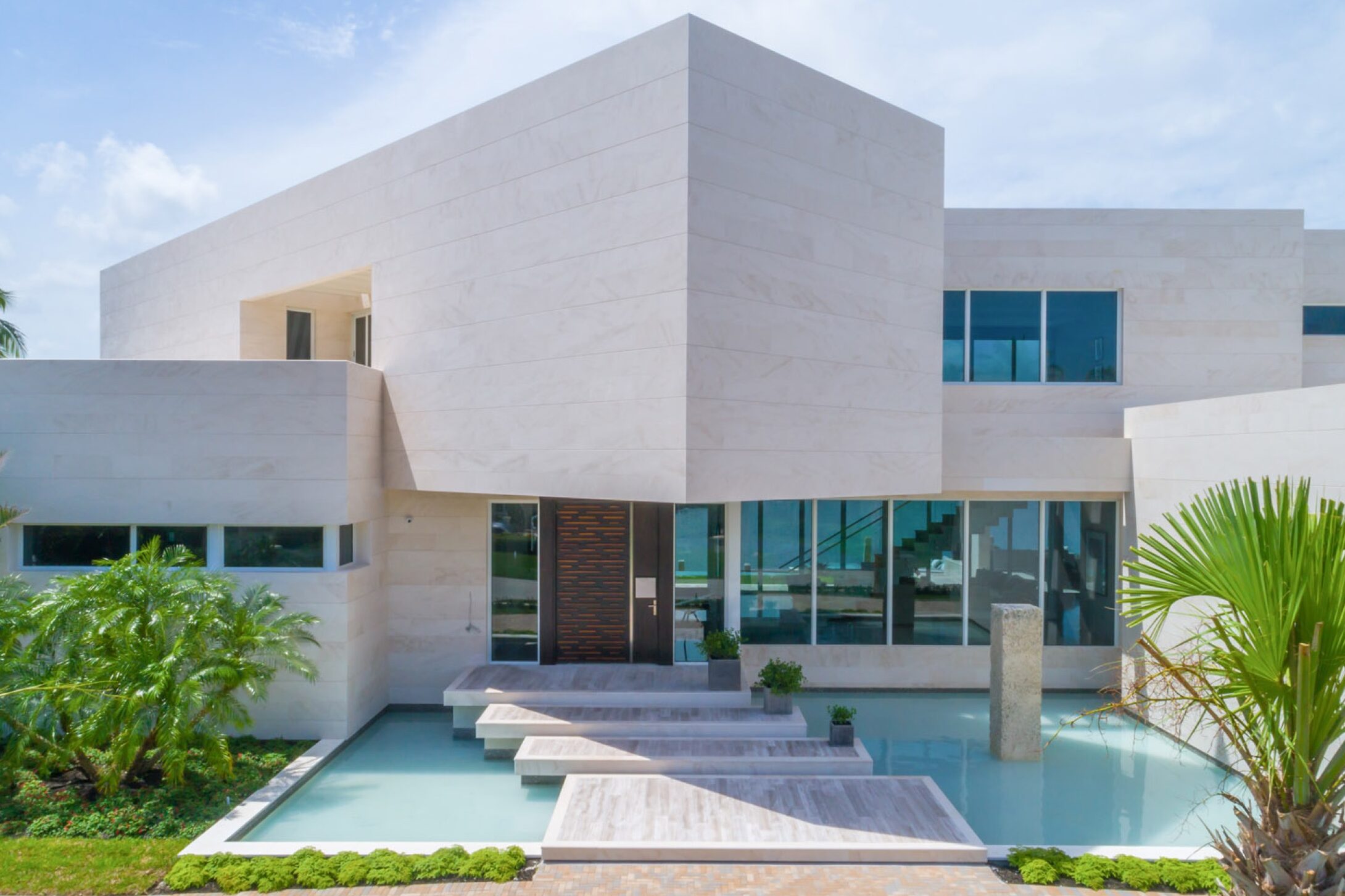
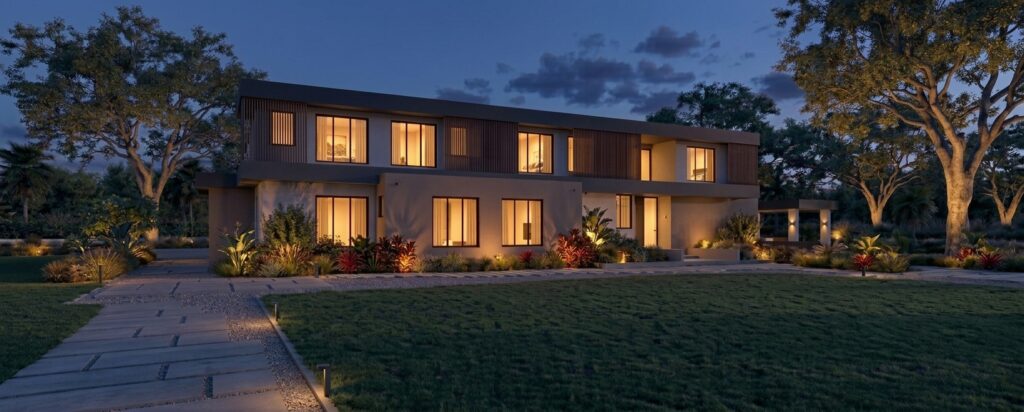
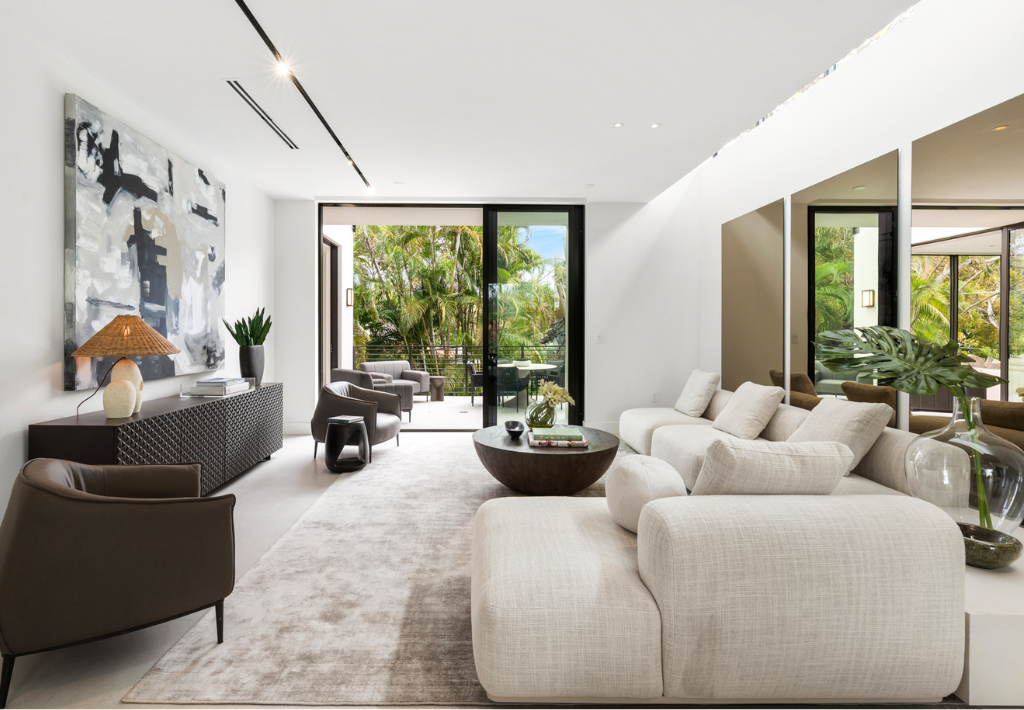
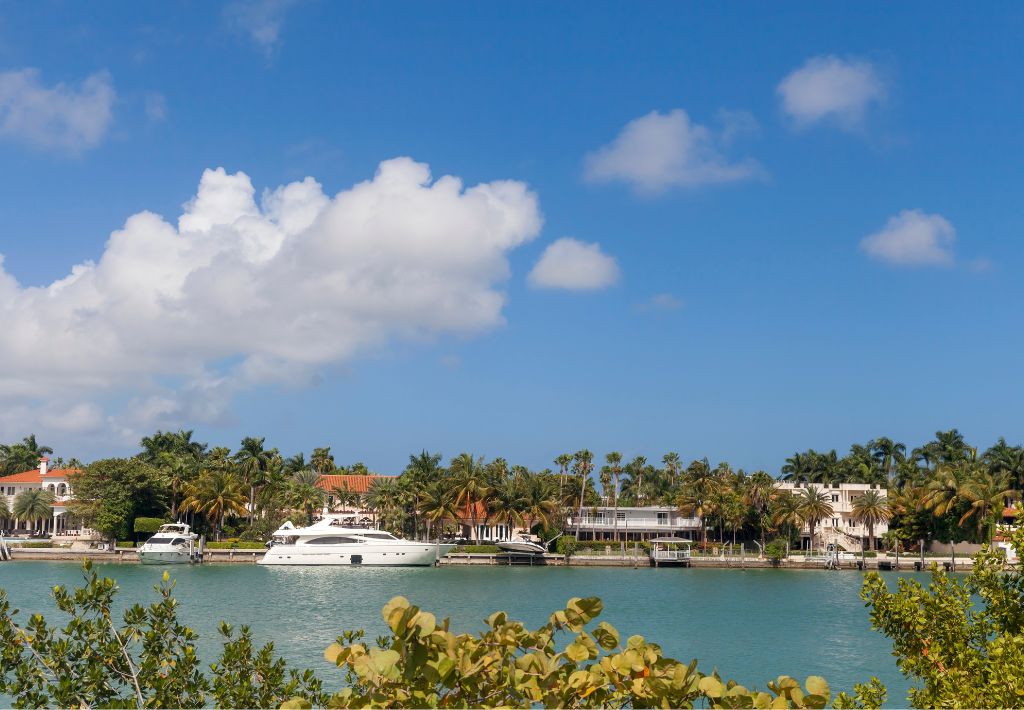
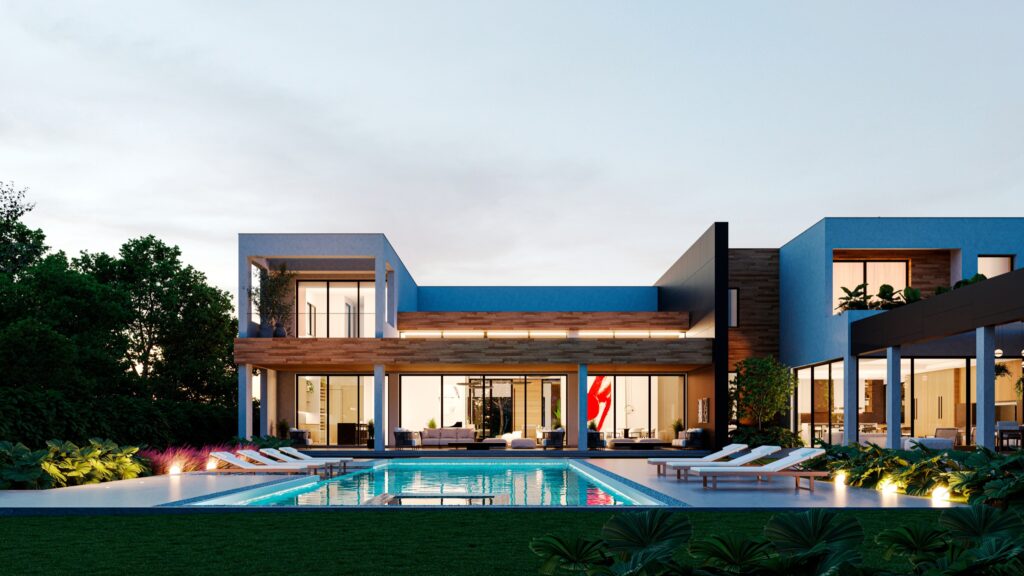
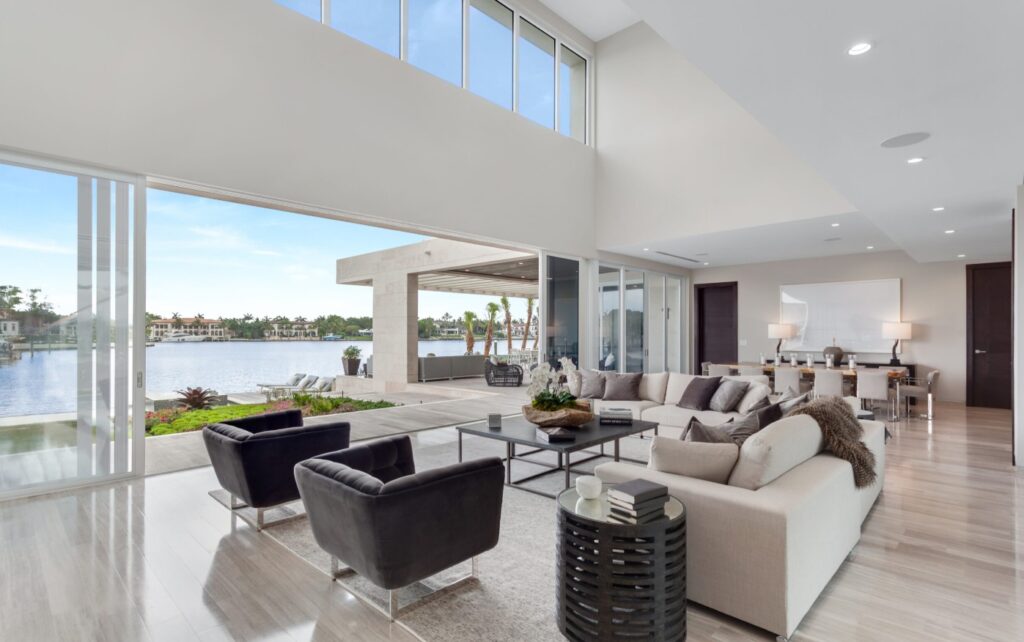
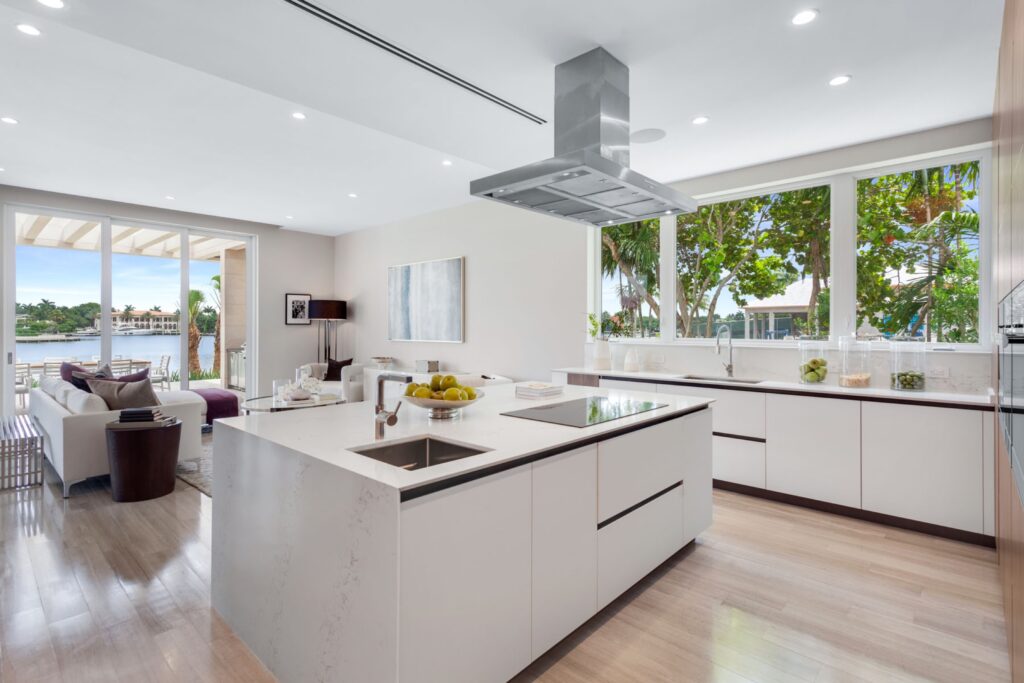
The project that clarified this for me the most was 445 Solano Prado in Gables Estates. 9,000 square feet, a 120-foot waterfront backyard. The brief, as it was shared with me, was to build the most visually significant contemporary residence in a neighborhood where every new home was competing for that same description.
The design move was a rotated upper volume. Not a subtle gesture. A deliberate rotation of the second level that does three things simultaneously, and none of them are purely decorative.
The first is visual dominance. On a street where every facade is vying for attention against more traditional Coral Gables architecture, rotation creates an instantly readable silhouette. The home announces itself from the approach in a way a straight-massed box never could. You see it and you know something intentional happened here.
The second is spatial discovery. The rotation produces terraces and sightlines that feel almost hidden (private in a way that straight geometry can't manufacture) until you arrive in them. Then they open everything. A terrace tucked behind the rotated mass that suddenly shows you the full bay. That isn't a feature listed in a brochure. It's an experience the architecture builds for you.
The third is a design lineage. The rotated mass is a direct nod to the Béton Brut concept, Le Corbusier's post-war philosophy of material honesty. Traditionally, this style is all about raw concrete left unfinished so that monolithic forms can play with light and shadow across their surfaces as the sun moves.
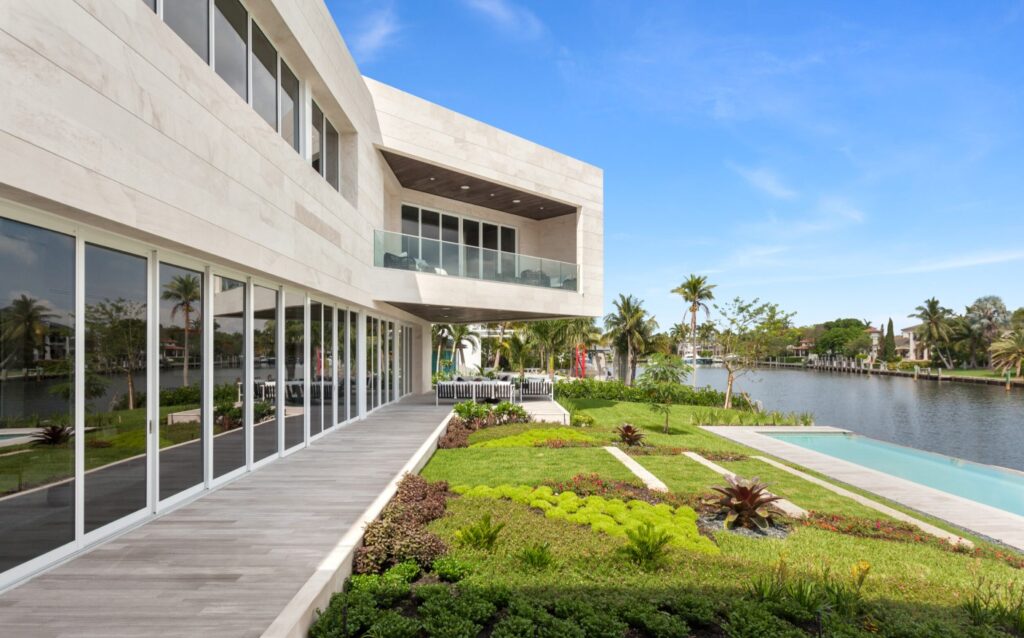
However, unfinished concrete wouldn’t work with Coral Gables architecture requirements, so we had to move this concept forward.
With material selection and honesty at the forefront and a neighborhood mandate for premium, we went all-in with this.
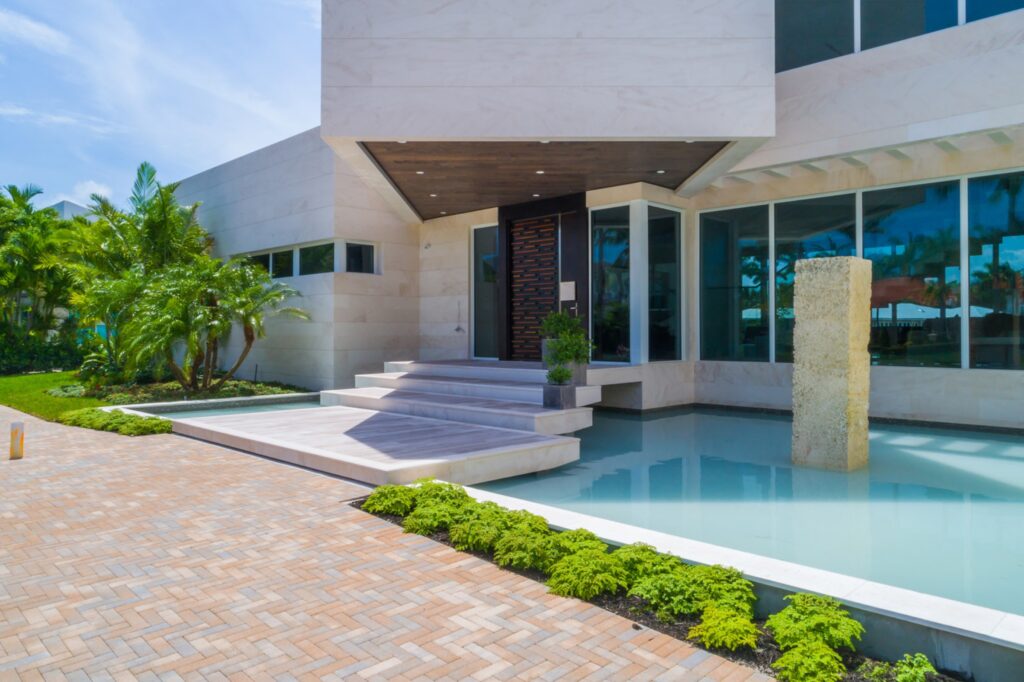
Our team flew to Spain to hand-select stone slabs from a quarry so exclusive, that we had to sign an NDA just to go there. Each piece was then processed on site to the exact specification of our BIM models. Then, each piece was prepped, packed, and sent here.

This was a premium level of the build that echo back to the days of the Rockefeller’s where European stone and materials were sent for, imported, and used in their legacy estates. We’re proud that the owners of Solano Prado have something like this to enjoy.
The result: the most architecturally distinctive residence in Gables Estates at completion, and the highest recorded sale in the community.
That outcome wasn't the market being generous. It was the direct consequence of a design decision (the rotation) that required a level of technical commitment most firms would have negotiated away from. The record wasn't set by the safer home. It was set by the hardest one to build.
What Solano Prado demonstrated is what I believe about Coral Gables architecture more broadly: this neighborhood is always about what’s on-trend. You can track the architectural history and market trends purely based on what was built and when - and what’s allowable (or not) right now!
Whether you’re evaluating a property in Coral Gables, or someplace else in Miami, three things matter before the design conversation starts.
The Board of Architects is not an obstacle. It's a filter. Every exterior project goes through BOA review, and preliminary approval comes before final approval, which comes before the permit. An architect who understands the Board's design standards (color compatibility, material integrity, fenestration proportions) moves through that process. One who don’t lose time in revision cycles that compound across a spec timeline. In Coral Gables architecture, the permit process is part of the project. It needs to be treated that way from day one.
Your style decision is a market decision. The question isn't just what you want the home to look like. It's who will buy it in ten or fifteen years and what they'll be looking for. At the top of the Coral Gables market, that buyer is increasingly design-literate, internationally mobile, and unimpressed by ubiquity. They're looking for a home that was designed with intention. In this particular case, it was about contemporary architecture, done with genuine intelligence. The design meant something to everyone and that’s why it works in this neighborhood.
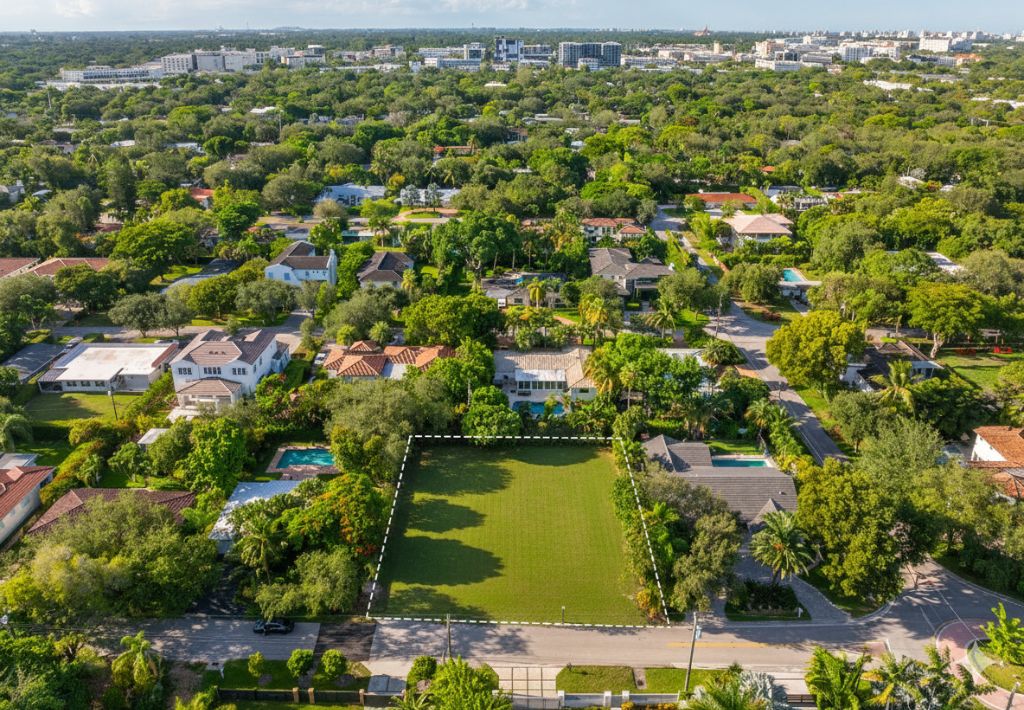
The site constraints shape the design before the design starts. Tree surveys and protection plans are required at permit application. Lot coverage limits constraint massing. Setback requirements determine what's actually buildable on a given parcel. These aren't bureaucratic footnotes. They're the parameters the design has to work inside from the first conversation. The architects who find opportunity inside those parameters are the ones who deliver the finished product that looks inevitable. The ones who discover the constraints late deliver revisions.
Ultimately, the conversation worth having about Coral Gables architecture isn't about which style is safest. It's about what your specific lot can become with an architect who understands this neighborhood's standards, its market, and the design lineage behind its most significant homes.
Codes change. What’s buildable changes. What doesn’t change is that an architect can help you realize something truly worldclass, but only if they’re on top of due diligence.
One email starts the conversation about what's possible on yours
Mediterranean Revival is the dominant and foundational style, established when George Merrick planned the city in 1925. Original Coral Gables architecture draws from Spanish, Moorish, Italian, and Byzantine influences and remains the majority of the historic housing stock. Mid-century Modern represents a significant portion of the post-war residential inventory and has developed a strong secondary market among buyers who recognize it. Contemporary architecture has emerged as the third distinct mode, reviewed by the Board of Architects on design merit rather than historical conformity. Most of the city's landmark buildings, including City Hall, the Biltmore Hotel, and Douglas Entrance, are Mediterranean Revival.
The Board of Architects evaluates all projects (including contemporary ones) for Coral Gables architecture based on compatibility of color, materials, fenestration, and proportion, not on adherence to any particular historical style. A well-designed contemporary home can win approval. But the BOA evaluates every project on a case by case basis where scope, impact, and relationships matter too. MIK Architecture's project at 445 Solano Prado is a concrete example of an innovative, but compliant project, done right: a contemporary design with a rotated upper volume and precision stone facade that earned BOA approval and went on to break the community's sales record.
Yes, for virtually any exterior project. All new Coral Gables archtiecture projects such as new construction, additions, exterior renovations, pool installations, and even paint color changes all require BOA review. For new residential construction, the process involves a preliminary approval and a final approval before the building permit is issued. The Board meets every Thursday. An architect experienced with the BOA's standards can reduce revision cycles significantly, which is where most of the timeline risk in a Coral Gables project actually lives.
The Board of Architects is the most immediate distinction. No other Miami-area neighborhood has an equivalent body with this level of authority over residential design. Beyond that, Coral Gables has mature tree canopies that trigger survey and protection requirements at the permit stage, significant lot variation across its sub-neighborhoods, and a buyer market that skews heavily toward design-literate, high-net-worth purchasers who can identify the difference between a thoughtful home and an expensive one. Coral Gables architecture, at its best, is designed for that buyer. The investment returns follow.